Finding Your Perfect Journal for Daily Writing: A Practical Guide
I have been writing daily for over thirty years. In that time I have filled dozens of notebooks, tried every binding and paper type I could find, and learned what works and what does not. A good journal for daily writing is not a luxury. It is the tool that either helps you keep a daily habit or quietly stops you from writing at all. The wrong journal can make you resent putting down a sentence. The right one makes you want to open it every morning.
When I started, I grabbed whatever notebook was cheapest. Spiral-bound, flimsy paper, lines that ran crooked. I wrote in it for a few weeks and then abandoned it. The problem was not my discipline. It was that the notebook fought me. The pages tore when I erased. The ink bled through to the other side. The spine cracked. I did not know then what I know now: the physical experience of writing matters. A journal for daily writing should disappear into your hand, not demand attention for its flaws.
What Makes a Journal Work for Daily Use
Daily writing is different from occasional journaling. When you write every day, small annoyances become big obstacles. A journal that stays flat when open, that takes fountain pen ink without bleeding, that fits in a bag without added weight - these details matter. Over time I have settled on a few qualities that separate a good daily journal from a decorative one.
Paper quality is first. Tomoe River Paper is famously thin and strong. It handles fountain pen ink and Pigma Micron pens beautifully, showing shading and sheen without ghosting too badly. But it is not for everyone. Some writers want a heavier page, one that feels substantial. Rhodia uses a coated paper that is smooth and bright, excellent for showing ink colours. The paper choice changes how the pen feels and how the page looks. You have to find what you can live with every day.
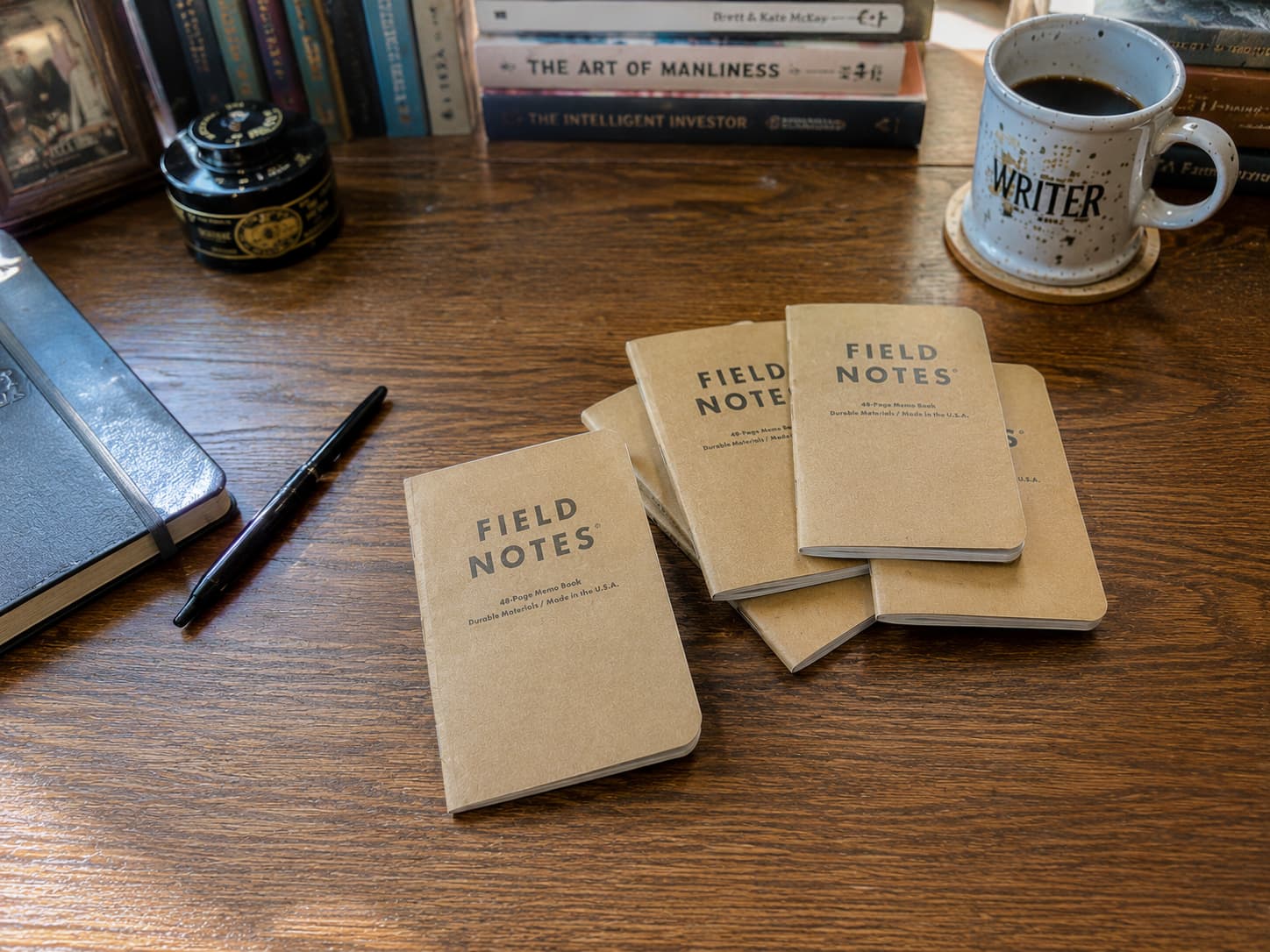
Binding matters. A soft cover notebook bends and flexes. It slides into a coat pocket or a bag easily. A hard cover protects the pages better and gives a firm writing surface anywhere. I keep a hard cover Leuchtturm1917 on my desk and a soft cover Field Notes in my bag. Each serves a different purpose. The hard cover stays open on its own, which matters when I write at a cafe with limited space. The soft cover is for quick notes on the go, for ideas that come while waiting in line.
Notebooks I Have Used and Trusted
I have tested most of the well-known brands. Some I have used for years. Others I bought once and never finished. Here are the ones that have earned a place in my rotation.
Leuchtturm1917 is probably the most popular brand among serious writers. It has numbered pages, a table of contents you can fill in, and a pocket in the back. The paper handles most pens well, though very wet fountain pens can ghost. I have used Leuchtturm1917 notebooks for morning pages for months at a time. The hard cover is sturdy and the elastic band holds the place. It is a safe choice for anyone starting a daily habit.
Moleskine is the brand many people think of first. I have mixed feelings. The classic Moleskine has thin paper that bleeds with fountain pens and even some rollerballs. The binding can crack if you open it flat. But the size is perfect for carrying around, and the elastic band closure is convenient. I use Moleskine notebooks when I know I will write with a ballpoint or pencil. For serious daily writing with fountain pens, I look elsewhere.
Rhodia makes a no-nonsense notebook. The paper is bright white, smooth, and coated. It shows ink well and dries fast. The orange cover is easy to spot. Rhodia notebooks are spiral-bound or staple-bound, which means they lie flat. They do not have the fancy features of a Leuchtturm1917. They are simply good paper in a simple binding. I use a Rhodia pad for drafting longer pieces.
Field Notes are small, thin, and durable. They come in many cover colours and hold up to rough handling. The paper is not as fountain-pen-friendly as Rhodia or Tomoe River Paper, but the size and feel make up for it. I keep a Field Notes notebook in my back pocket for notes that do not need to be perfect. They are great for jotting down ideas, making lists, or writing in places where a big notebook would be awkward.
Hobonichi Techo is a cult favourite for a reason. The paper is Tomoe River Paper, and the binding is thread-sewn so it opens flat. The pages are thin but strong, and you can write on both sides without show-through. The Hobonichi Techo comes in a day-to-a-page layout, which suits structured daily writing. I have used one for morning pages and found that the daily date and space encourage consistency. The cover is soft and comes in many designs, but the notebook itself is lightweight.
Midori MD Notebook is another excellent choice. The paper is smooth and cream-coloured, with a pleasant tooth that slows the pen just enough. It works well with fountain pens and pencils. The cover is simple paper, which can get scuffed and stained. Some people love that worn look. Others want a protective cover. Midori offers a clear plastic cover separately. I have used Midori notebooks for bullet journal layouts and long-form writing alike.
Baron Fig makes notebooks that are designed with the writer in mind. They have a dot grid option, a lay-flat binding, and a pocket in the back. The paper is thick and takes ink well. The hard cover version is solid. I have used Baron Fig notebooks for project planning and daily logs. They are not as widely available as Leuchtturm1917 or Moleskine, but they hold up well to daily use.

Choosing the Right Format
Paper ruling is a personal choice. I have used grid paper, lined paper, and blank pages. Grid paper works well for bullet journal layouts and for keeping handwriting straight without the constraint of lines. Lined paper is classic and familiar. Blank pages give total freedom but require you to manage spacing yourself. I prefer grid paper for most daily writing because it gives structure without being rigid.
Binding type matters for how the notebook feels in use. Soft cover notebooks are flexible and portable. Hard cover notebooks are durable and provide a writing surface anywhere. Some writers prefer spiral binding because it lets the notebook lie flat and you can tear out pages. Others want a sewn binding that will not shed pages over time.
Size is another factor. A pocket-sized notebook like Field Notes fits in a pocket but has small pages. An A5 notebook is large enough for substantial writing but still fits in a bag. A B5 or A4 is for desk use only. I have found that an A5 soft cover with grid paper is the most versatile size for daily writing. It is big enough for morning pages and small enough to carry.
Building a Daily Habit Around Your Journal
Having the right notebook is only half the work. The other half is showing up every day. I have used the morning pages practice from The Artist's Way for years. The idea is to write three pages of stream-of-consciousness thoughts every morning. It clears the mind and builds a daily habit. A journal for daily writing that you look forward to opening makes this practice easier.
I also use writing prompts when I am stuck. A simple prompt like "What did I notice today?" or "What is bothering me?" can get the pen moving. Some notebooks come with prompts printed on the pages. I prefer a blank page and my own prompts, but I know writers who like the structure of guided questions.
The key is to make the act of writing frictionless. Keep your notebook and pen together. Write at the same time each day if you can. Do not worry about writing well. A daily journal is for writing badly, honestly, and freely. The only rule is that you write something.
What I Have Learned After Years of Testing
I have not found one perfect notebook. I have found several that are excellent for different purposes. My advice is to try a few. Buy one Leuchtturm1917, one Midori MD Notebook, one Hobonichi Techo. Write in each for a month. See which one makes you want to write. The best journal for daily writing is the one you actually use.
Do not be afraid to switch. I have gone through periods where I used a Moleskine every day for months and then switched to a Rhodia pad because I wanted a different feel. Your needs change. Your writing style changes. A new notebook can reinvigorate a stalled habit.
Paper quality matters more than brand name. A cheap notebook with good paper is better than an expensive one with paper that bleeds. I have used notebooks from all the brands I mentioned, and the common thread is paper that takes ink without bleeding or feathering. Tomoe River Paper is the gold standard for fountain pen users. For ballpoint or pencil users, almost any paper works.
Ultimately, the notebook is a tool. The real work is the writing. But a good tool makes the work easier. If you are trying to build a daily writing practice, invest in a notebook that you will enjoy using. Spend a little more for paper that feels good under your pen. Buy a cover that pleases your eye. Small pleasures add up over the course of a year of daily writing.